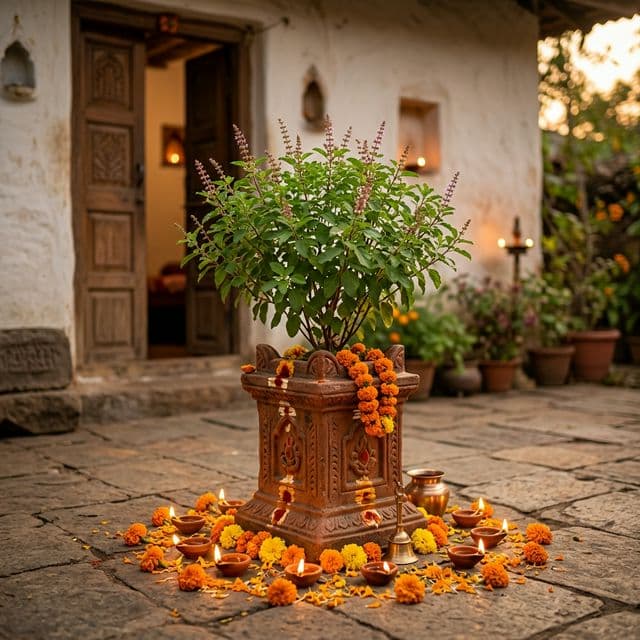
The Tulsi (तुलसी) or Holy Basil (Ocimum tenuiflorum) holds a position unlike any other plant in Hinduism — it is not just a plant, but a living goddess. Found in the courtyard of nearly every Hindu household, the Tulsi is worshipped daily, and no puja or offering to Lord Vishnu is considered complete without Tulsi leaves.
The Mythology of Goddess Tulsi
According to the Padma Purana, Tulsi was originally Vrinda — a devoted wife whose unwavering fidelity made her husband, the demon king Jalandhar, virtually invincible. When Lord Vishnu, through divine play, broke her spell of fidelity to enable the gods to defeat Jalandhar, Vrinda was heartbroken.
Moved by her devotion, Lord Vishnu blessed her: "You shall be reborn as the sacred Tulsi plant, and I will never accept any offering without your leaves. You shall reside at my chest forever." This is why Tulsi is also called Vishnu Priya (beloved of Vishnu).
Why Tulsi is Worshipped Daily
Evening Aarti to Tulsi: In millions of Indian homes, women light a diya near the Tulsi plant every evening and perform a small aarti. This ritual:
- Purifies the air around the house (Tulsi releases ozone, O₃)
- Creates a positive spiritual energy field
- Invokes Goddess Lakshmi's blessings for the household
Tulsi Vivah: Every year on Prabodhini Ekadashi (Dev Uthani Ekadashi), the ceremonial marriage of Tulsi with Lord Vishnu (in the form of Shaligrama stone) is celebrated. This marks the beginning of the Hindu wedding season.
Scientifically Proven Health Benefits
Modern science has validated what Ayurveda knew for thousands of years:
- Immunity Booster: Tulsi leaves contain eugenol, ursolic acid, and rosmarinic acid — powerful immunomodulatory compounds
- Stress Reliever (Adaptogen): Classified as an adaptogenic herb, Tulsi helps the body adapt to stress and normalizes cortisol levels
- Respiratory Health: Chewing 4-5 Tulsi leaves daily helps with cough, cold, bronchitis, and asthma
- Blood Sugar Regulation: Studies show Tulsi can help reduce blood glucose levels in Type 2 diabetes patients
- Anti-bacterial & Anti-viral: Tulsi extract is effective against E. coli and other harmful bacteria
- Air Purification: A single Tulsi plant can produce oxygen for 20 hours a day and absorb CO₂, CO, and SO₂
How to Care for Your Tulsi Plant
- Water daily but avoid over-watering
- Place in a spot with 6+ hours of sunlight
- Never pluck leaves on Sunday (considered Vishnu's rest day)
- Pluck leaves gently in the morning for puja
- Add compost or cow dung manure monthly