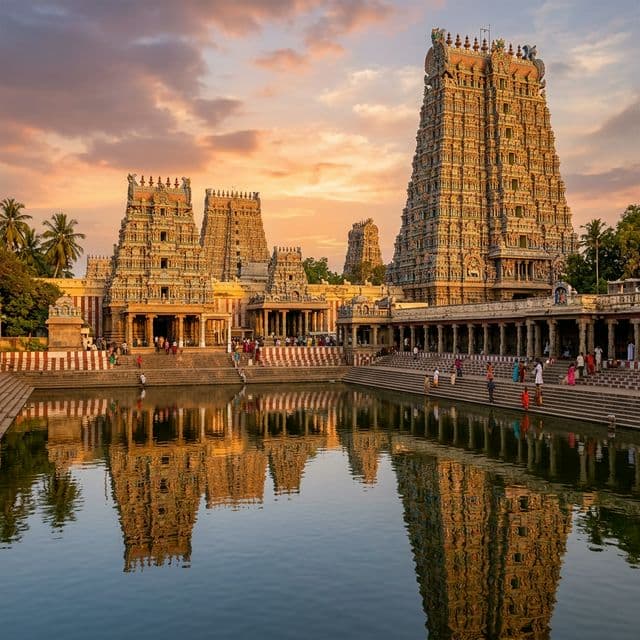
A Hindu temple is not merely a building — it is a living embodiment of the cosmos itself. Every element, from the foundation to the tallest spire, is meticulously designed according to ancient sciences of Vastu Shastra (architectural science) and Agama Shastra (ritual science) to create a space where the human and divine can meet.
The Temple as a Cosmic Body
The temple layout mirrors the human body:
- Garbhagriha (Sanctum Sanctorum): The womb/heart where the deity resides
- Antarala (Vestibule): The neck connecting the heart to the head
- Mandapa (Hall): The body where devotees gather
- Gopuram (Tower): The crown/head reaching toward the heavens
- Dwajastambha (Flagpost): The spine, the central energy axis
Two Great Architectural Traditions
1. Nagara Style (North India)
- Characterized by a curvilinear Shikhara (tower) over the sanctum
- Famous examples: Khajuraho temples, Kandariya Mahadeva, Somnath Temple
- The tower curves inward and peaks at the Kalasha (sacred pot finial)
2. Dravidian Style (South India)
- Features massive Gopurams (gateway towers) covered in thousands of painted sculptures
- The tallest tower is at the entrance, not the sanctum
- Famous examples: Meenakshi Temple (Madurai), Brihadeshwara (Thanjavur)
- The Vimana (tower over sanctum) is comparatively modest and pyramidal
The Science of the Sanctum
The Garbhagriha is designed as a perfect square, completely dark except for the lamp light. This darkness is intentional — it represents the formless Brahman from which all creation emerges. When the priest opens the doors and the light of the diya illuminates the deity, it symbolizes the moment of cosmic creation.
The sanctum rests on a Brahmasthana — a specific point calculated through Vastu where the Earth's magnetic energy is concentrated. This is why devotees report a profound sense of peace and energy when standing before the deity.
Why Temples Use Specific Stones
- Granite: Used in South Indian temples for its ability to store and radiate subtle energy
- Marble: Used in North Indian temples for its cooling properties and purity symbolism
- Sandstone: Used in Rajasthani temples, resonates with the desert landscape
The Pradakshina (Circumambulation)
Walking clockwise around the sanctum is not ritual for ritual's sake. The sanctum generates a subtle electromagnetic field, and walking around it exposes the devotee's body to this field from every angle — a form of ancient energy therapy.